
Longevity isn’t only what you take or apply - it’s the spaces you inhabit.
For years, a wellness feature meant a gym in the basement or a spa tacked onto a hotel lobby, a nice extra, not something that actually changed your health. That thinking is now out of date.
Where you live, sleep, train and recover isn’t a backdrop to your health, it’s part of it. Stress, sleep, movement and recovery don’t sit in separate boxes to be managed one at a time; they feed into each other, day after day. And the biggest single influence on which way that balance tips - towards repair, or towards wear - is the environment a person spends their life in.
This isn’t just a theory. Some 95% of people believe their home affects their health, and 73% now say health is a deciding factor when choosing where to live next, according to John Burns Research & Consulting. The market is already responding: searches for home saunas rose 84% in the UK between 2020 and 2024 (Semrush), and the UK cold-plunge market is on track to grow from $314.0m to $430.9m by 2029 (Data Bridge Market Research). None of this is a passing wellness trend. It’s proof of a much simpler idea: that where you live and recover is now part of how well you age.
The science behind the shift
Health psychologist Dr Elissa Epel, director of UCSF’s Aging, Metabolism, and Emotion Center, has a name for what’s driving much of this: hormetic stress.
“There’s a type of stress we call hormetic stress - short-term, intermittent stressors that we control, that we can titrate the dose of, so we’re pushing ourselves to an edge, but not over it. High-intensity interval training is a great example. Cold plunges and Wim Hof breathing are other trends becoming more popular with women, though the protocol for women on these behaviours is new in its thinking.”
- Dr Elissa Epel, director, UCSF’s Aging, Metabolism, and Emotion Center
These practices aren’t worth taking seriously because they’re trendy. They’re worth investing in because, unlike a lot of health interventions, their benefits don’t fade after one use - they build over months and years.
“Lifestyle becomes one of our most important levers for slowing biological ageing, in ways that are scientifically supported, free, and accessible to the population at large. Lifestyle wins over pharmacotherapeutics. It has one of the largest effects - and part of that is because lifestyle is lifelong, and its effects are cumulative.” Dr Elissa Epel
Crucially, she adds, there’s no expiry date on this.
“There isn’t a cut-off point at which this stops mattering. The mechanisms that slow ageing in midlife continue to work decades later, which is why environment-led intervention pays off whenever it’s introduced, not only within a narrow window early in life.”
Dr Elissa Epel
Already under construction
A handful of developers and hospitality brands aren’t waiting to see if this becomes a trend - they’re building it in already.
At The Well’s Miami Bay Harbor Islands complex, opened in 2025, wellness has been designed into the architecture rather than offered down the hall: every apartment has the option of an affusion spa shower built into the bathroom, intended to help stimulate the lymphatic system, reduce water tension and increase energy. The signal is structural as much as aesthetic - it’s a telling choice: recovery built in like plumbing or heating, something every apartment simply has, rather than a members’-only extra.
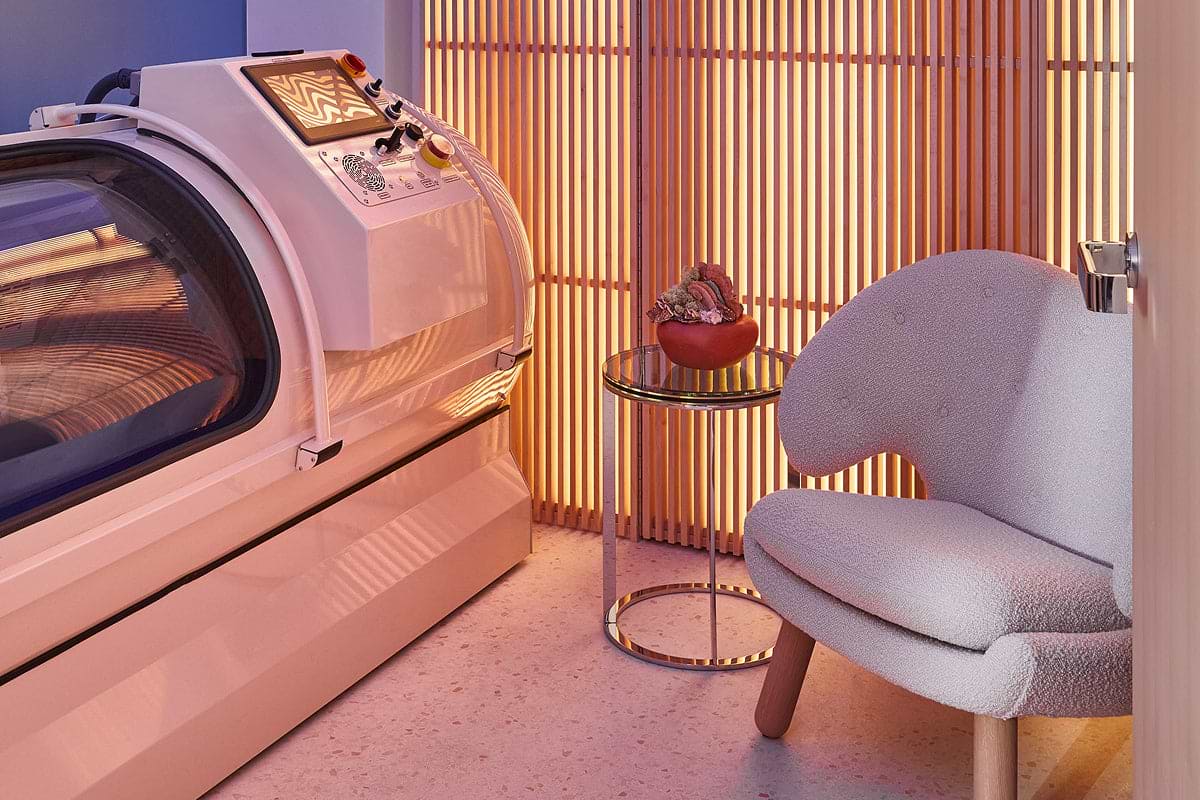
New York’s 113 Spring has taken the same logic into shared, city-facing space with its newly opened Recalibration Room, home to an upgraded Ammortal Chamber. A single session combines PEMF, red and near-infrared light, vibroacoustics, molecular hydrogen and guided breathwork in one restorative sequence - the same principle behind a stress-recovery routine, but applied at architectural scale: regulating the nervous system and quieting the mind rather than simply relaxing the body for an hour. The space also connects bio-designers, health practitioners and creative studios - curation intended to keep the science behind each modality credible, rather than layering trend-on-trend.
Surrenne - the private wellness club at The Emory, Maybourne’s hotel in Belgravia - is drawing the clearest line yet between old and new spa language. Its programmes are deliberately not sold as an escape from daily life. The aim is restoration, not withdrawal. Its City Circadian Reset makes the point explicit, built on the same sleep-first thinking behind the internal clock that governs sleep, alertness, metabolism and hormone release, rather than a temporary break from the pace of the city. The premise is that a disrupted rhythm is the root cause behind fragmented sleep, low energy and low mood, not three separate problems to treat one at a time. Every programme starts with a personal assessment and continues as an ongoing protocol, not a single intensive week you recover from once and then forget.
Reading the signal correctly
It would be easy to dismiss all this as self-indulgence. The numbers say otherwise. Among beauty and wellness early adopters, mindfulness and mental wellbeing rank as the second-biggest priority for the future, at 51% - just one point behind longevity and healthy ageing itself, at 52% (Future:Poll™). People aren’t choosing calm over health. Increasingly, they see them as the same thing.
It also shows a more balanced approach than the industry tends to give people credit for. Among the same group, 55% don’t sit at either extreme - they’re neither purely science-led nor purely lifestyle-led (Future:Poll™). That’s not a lack of conviction. It’s an accurate read of how the body actually works: a cold plunge won’t replace a clinical protocol, and a clinical protocol won’t replace sleep and rhythm. Most people are already doing both, because the body needs both.
This is precisely the territory the LYMA Power Index was built to navigate. The Index judges an investment not by how it makes someone feel in the moment, but by three questions in particular: is it Proven, does it treat the body as a Whole-System rather than a single symptom, and does it offer Return - value that compounds with repetition, not a one-off reset.
Measured against that standard, the strongest environment-led spaces are the ones that pass on more than one count at once: The Well’s affusion showers and 113 Spring’s Recalibration Room are built around named, explainable mechanisms rather than vague relaxation claims; Surrenne’s model is structured around ongoing protocols precisely because a single visit was never going to be where the value lived.
That is the more useful way to think about the shift this piece opens with. Environment isn’t a wellness amenity to be added once the “real” health decisions are made elsewhere - it’s one of the few longevity levers available every single day, whether or not a person is actively thinking about their health at all. The room someone showers in, the temperature they choose to sit in, the rhythm their week is built around: each is already doing something to their biology, for better or worse. The only real choice is whether that influence is designed on purpose, or left to chance.
The health industry is moving beyond products and protocols and into spaces and systems. As it does, intent is what will separate genuine investment from style with nothing behind it. The brands worth watching and investing in won’t be the ones with the best-looking room. They’ll be the ones who can say, precisely and show proof, how the rooms we sit in and the environment that surrounds us is supporting our bodies. They will be able to show why they deserve to be part of our everyday routines and rituals - because doing so, day after day, is what turns a room into a return.
Apply the standard to your own environment
Proven, Whole-System, Return: the same three questions the Index asks of a Supplement or a skincare device apply just as well to the room you’re sitting in right now.


