
Why one fibre is never enough - and what the longest-living populations have always known.
A tale of two populations

There are people alive today, in Okinawa, in Sardinia, in the highlands of Ikaria, who are outliving the rest of the Western world by decades. Not because they have access to better medicine. Not because their genetics are exceptional. But because of what they eat.
Professor Paul Clayton has spent five decades trying to understand exactly why. A medical pharmacologist by training, former Senior Scientific Advisor to the UK government’s Committee on the Safety of Medicines and one of the world’s leading experts in pharmaco-nutrition, Professor Clayton has studied the nutritional habits of the world’s longest-living populations - the Blue Zones past and present - with one central question driving his research: what are they consuming that the rest of us are not?
The answer, when it came, was consistent across every population he studied. It was not a single superfood. It was not a supplement regimen. It was a nutritional architecture: high in diverse prebiotic fibre, rich in Omega-3s in their naturally protected forms, and supported by a full spectrum of bioavailable minerals, that the modern Western diet has almost entirely dismantled.
The link between that architecture and their longevity is not abstract. A diet consistently rich in diverse prebiotic fibre and naturally protected Omega-3s builds and sustains a gut microbiome of exceptional quality and diversity. And it is that microbiome, more than any other single factor, that underpins the immunity, cognition, energy and cellular health that defines not just how long a life is lived, but how well. The longest-living populations are not simply eating well. They cultivate the biological foundation that everything else depends on.
In the second half of the 19th century, people were consuming between 40 and 50 grams of prebiotic fibre a day. Today, the average Western diet delivers around 4. In the space of a single century, the primary food source of the healthy microbes that should be living inside us has quietly been structurally removed.
“Most people are living below their biological potential without knowing it. Not because they’re ill. Because they’re under-resourced. That is a nutritional problem. And nutritional problems can be corrected.”
LYMA ID² is his answer to that correction: a formula built around four precisely chosen prebiotic fibres, engineered to feed every section of the colon simultaneously - the nutritional restoration the modern diet has never been able to provide on its own. Understand the science behind LYMA and why fibre diversity is the foundation of lasting health.
The problem: why most gut supplements are built on incomplete science
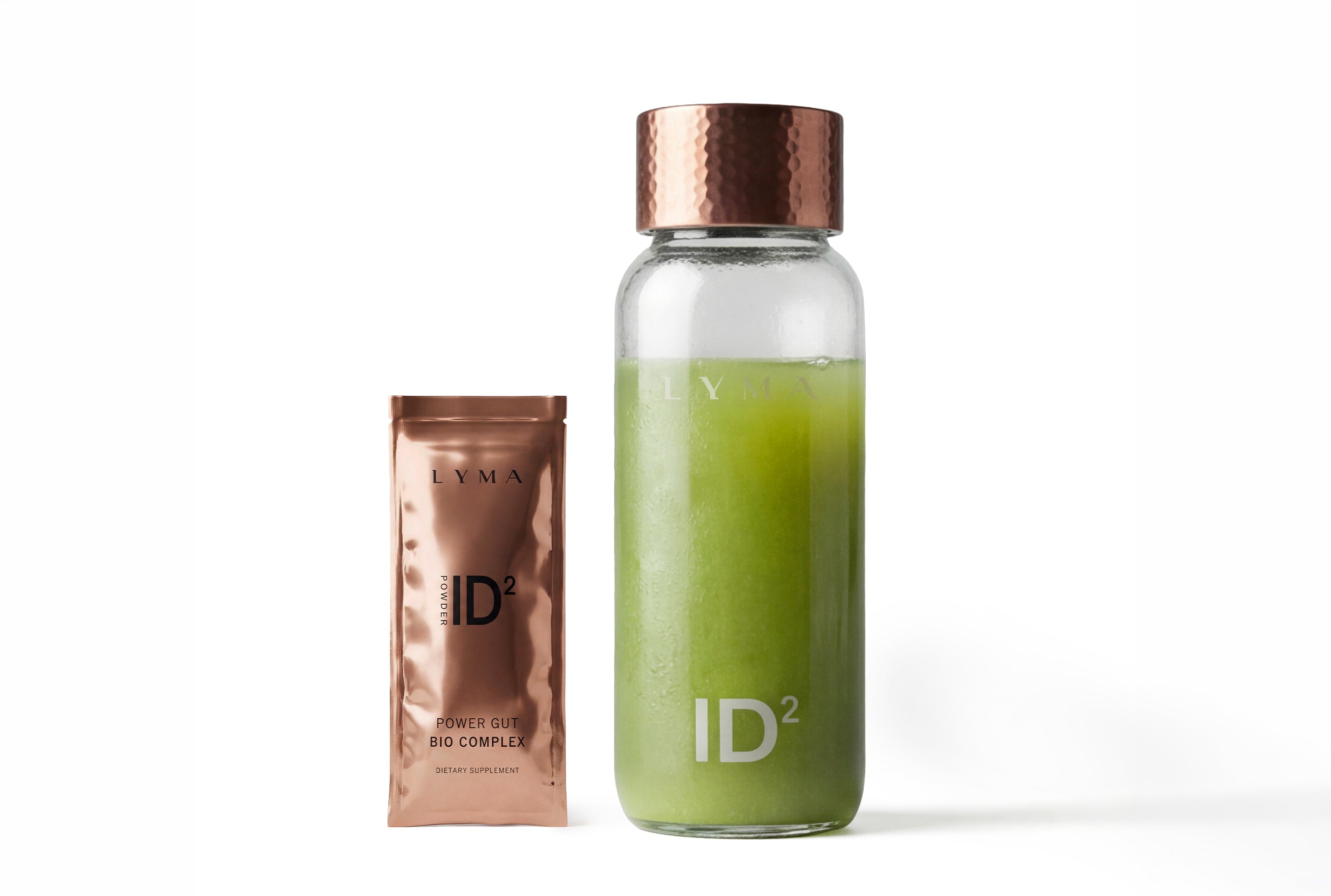
To understand why most gut supplements fail, you first need to understand the architecture of the colon, and then look honestly at what the supplement category has chosen to put inside its products.
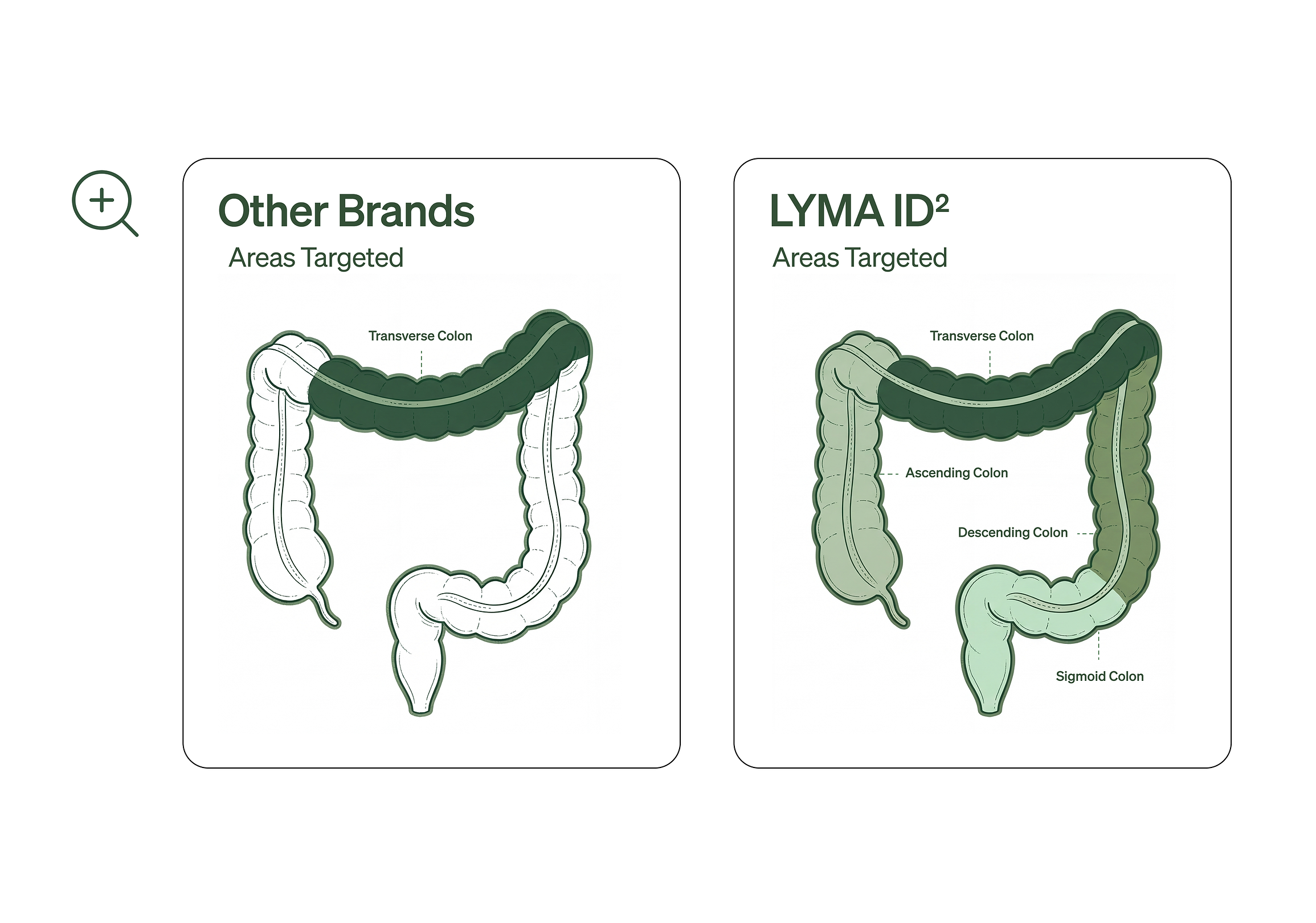
The colon is not a single chamber. It has four distinct sections - the ascending, transverse, descending and sigmoid colon - each with its own characteristically different bacterial population, each performing specific and critical biological functions. Those bacterial populations need feeding. And the food they depend on is prebiotic fibre.
The vast majority of gut supplements contain no prebiotic fibre at all. They are probiotic-only formulas, live bacteria delivered into a gut that has nothing to feed them. As Professor Clayton explains it:
“It’s like trying to plant seeds in concrete. The seeds aren’t the problem. It’s the soil.”
Without prebiotic fibre, those bacteria arrive, find nothing to feed on, and pass straight through without colonizing. The supplement has done nothing. The gut remains exactly as it was.
The rare supplements that do include a prebiotic typically rely on a single strain - and this is where a second structural failure emerges. Different prebiotic fibres of different chain lengths ferment at different rates. A short-chain fibre reaches the ascending colon and is spent before travelling further. A longer-chain fibre travels deeper. A single prebiotic fibre will nourish one section of the colon and leave the others without resource. This is not a minor inefficiency. It is a structural failure at the heart of almost every gut supplement on the market.
The concept that corrects it is fibre length engineering: the deliberate selection of multiple prebiotic fibres of different chain lengths, chosen because they ferment at different rates and reach different destinations within the colon simultaneously. Four fibres, each a different chain length, each with a different fermentation profile, feeding every section of the colon in a single daily dose.
LYMA ID² delivers exactly this. Its prebiotic complex comprises four carefully chosen fibres: IMOfibe®, PromOat® oat beta-glucan, chicory inulin and fructooligosaccharides, totalling 8.5 grams per serving. Each reaches a different section. Together, they achieve what no single-fibre supplement can: full-colon coverage.
The significance extends beyond digestion. Every long-lived population Clayton studied shared the same nutritional signature: high prebiotic fibre diversity, consumed consistently across a lifetime. Not a single fibre but many. LYMA ID²’s four-fibre system is the closest modern science has come to replicating that diversity in a single daily dose.
The science in action: what happens when every section gets fed
When prebiotic fibre reaches the right bacteria in the right section of the colon, those bacteria ferment it and produce short-chain fatty acids (SCFAs). It is this mechanism that connects fibre length engineering directly to the longevity outcomes Clayton spent five decades studying.
SCFAs fuel the cells lining the colon wall, maintaining the integrity of the gut epithelial barrier - the body’s first line of defence against compounds that should stay in the gut and out of the bloodstream. When that barrier is compromised, inflammation increases, immune function is disrupted and nutrient absorption falls. A well-fed colon producing SCFAs across all four sections is a colon actively defending every other system in the body.
Via the gut-brain axis, SCFAs influence brain chemistry directly. Approximately 90% of the body’s serotonin is produced in the gut. When the microbiota is depleted and SCFA production is partial, those signals weaken. The fatigue, the brain fog, the low-grade sense of not functioning at full capacity that so many people in midlife report - these are symptoms of the same underlying deficit. A deficit that Blue Zone populations, eating 25 to 140 grams of diverse prebiotic fibre daily, simply do not have.
IMOfibe® ferments rapidly in the ascending colon. PromOat® oat beta-glucan travels into the mid-colon, also supporting healthy cholesterol metabolism. Chicory inulin selectively stimulates Bifidobacterium in the mid to distal sections. Fructooligosaccharides reach the distal colon - communities that single-fibre supplements never reach. Together: 8.5 grams of precisely targeted prebiotic fibre, against the modern diet’s average of under 4. Fibre length engineering is not a product feature. It is the scientific restoration of a nutritional pattern the longest-living people on earth have always lived by.
“There is barely a ceiling on what a fully nourished biological system can do.”
Why LYMA ID² goes further: the system behind the science

Fibre length engineering is the foundation. But LYMA ID² does not stop there. Understanding why requires understanding how Professor Clayton thinks about supplementation - not as individual ingredients added to the body, but as a complete biological system where every element enables every other.
DHA - essential for brain, heart and cellular health - is also one of the most fragile molecules in nutrition. Once consumed, it begins to oxidize. In nature, DHA never travels alone; it is always paired with protective polyphenols that shield it from oxidation. The fish oil industry strips those protectors out. LYMA ID² restores the natural pairing. Algia™ delivers 250mg of algae-derived, completely vegan DHA - the original, most stable source. Oleacore®, a patented olive polyphenol complex at 150mg, travels alongside it, sheltering the DHA and ensuring it arrives at the cell intact and at full biological capacity.
Oleacore® also activates SIRT1 - the protein most closely linked to longevity, cellular repair and metabolic regulation. SIRT1 activation is one of the biological signatures of the longest-lived populations. It is a pathway that modern food has left almost entirely unstimulated. LYMA ID² restores it deliberately, as part of the same formula simultaneously restoring the gut foundation everything else depends on.
The prebiotic fibres prepare the colon. ActiBio® arrives alive into the environment they have created. Algia™ DHA is absorbed by a microbiome now equipped to metabolize it. Oleacore® shields it and activates the longevity pathway at the cellular level. Each ingredient enables the next. The sequence is not accidental - it is the product of five decades of research into what the body actually needs and what the modern diet has consistently failed to provide. Read more in the LYMA Journal.
The longest-living populations were not taking supplements. They were simply eating in a way that naturally delivered these compounds, in these combinations, across a lifetime. LYMA ID² is the scientific answer to what happens when that way of eating is no longer available to us.
“Most people are living below their biological potential without knowing it. Not because they’re ill. Because they’re under-resourced.”
LYMA ID² was built on the science to change that. Ingredient by ingredient. Section by section. Cell by cell.
Ready to restore your biological foundation?
LYMA ID² is FSA and HSA eligible. Shop LYMA ID².
Learn more about our verified science.
You may also enjoy: "I Feel Cleaner, Lighter, More Energised - and My Skin Just Radiates", LYMA ID²: Why Harrods Had to Have It First.


