

Why alcohol feels like it helps you sleep - and what it's really doing.
You already know the official line: alcohol is bad for sleep. And yet you fall asleep faster after a glass of wine than you do most nights stone-cold sober - so the official line clearly isn't the whole story. It isn't. What's actually happening is stranger, and better documented, than "alcohol is bad for sleep" makes it sound.
Alcohol is, at the same time, a sedative and a stimulant - just on a delay. A 2026 narrative review pulling together a decade of research on alcohol and sleep described how ethanol acts on the brain's neurotransmission, sleep homeostasis, circadian regulation, thermoregulation and metabolism all at once, and not all in the same direction. The part that puts you to sleep quickly happens in the first hour. The part that wakes your body back up happens for the rest of the night, while you're still lying there believing you're asleep.
Why alcohol makes you sleepy in the first place

The sedative effect is real, and it comes down to one mechanism: ethanol enhances the activity of GABA, the brain's main calming neurotransmitter, at the same receptor targeted by many prescription sedatives. That's why a drink lowers sleep onset latency - the time it takes to fall asleep - reliably and quickly.
It's also why the specific drink barely matters. Whiskey doesn't have some unique sedative property that wine or beer lacks; a nightcap "working" is ethanol working, at whatever dose you happened to take it. If you're already running on very little sleep, that GABA effect stacks on top of your existing sleep pressure, which is part of why a nightcap can feel especially effective on the exact nights you're most exhausted - and why it's also the least reliable night to trust it.
What actually happens when you try to sleep after drinking

The stimulant half of the story shows up later, and it's counterintuitive. A large 2026 real-world study monitoring over 85,000 people across 2.3 million nights found that, on nights with alcohol, people spent 3.97% more time awake after initially falling asleep and got 1.71% less REM sleep - the stage tied to dreaming, memory and emotional processing. Deep sleep, however, ticked up slightly by 1.38%, which cuts against the common assumption that alcohol simply erodes every stage of sleep equally. It doesn't. It trades REM and continuity for a small amount of extra deep sleep early on, then fragments the second half of the night as the body works to clear the alcohol.
A separate meta-analysis of 27 studies found this is dose-dependent: even a low dose, around two standard drinks, was enough to disrupt REM sleep, while roughly five drinks were needed to meaningfully shorten sleep onset latency - meaning the "falls asleep faster" effect most people chase actually requires more alcohol than the amount already quietly wrecking their REM sleep.
There's a knock-on effect the next morning, too. A study of 251 women with sleep and pain complaints found that each additional drink pushed next-morning waketime back by around 8 minutes - a small, dose-dependent delay that adds up: five drinks, and you're waking up roughly 40 minutes later than your body clock expects, groggy in a way that feels like poor sleep because, in circadian terms, it is.
Tips for how to sleep after drinking

Full abstention removes the problem entirely, but if you're drinking, a few adjustments measurably limit the damage.
Drink earlier, not later
The body processes roughly one unit of alcohol per hour. Finishing your last drink at least four hours before bed gives your system meaningful time to clear it before the fragmentation effects set in overnight.
Skip the nightcap specifically
A drink right before bed is the version most likely to still be disrupting your REM sleep and raising your heart rate several hours later, precisely when your body should be settling into its deepest, most restorative stretch of the night.
Cap it and hydrate alongside it
Alcohol suppresses vasopressin, the hormone that normally tells your kidneys to conserve water - which is why you produce more urine than the volume you actually drank, and wake up dehydrated even after "enough" water alongside it. If it's a celebratory night, keeping consumption under roughly six units and matching each drink with a glass of water helps offset this directly, rather than just diluting the alcohol.
Replace what alcohol actually depletes
Alcohol interferes with the body's absorption and storage of thiamine (vitamin B1), which is part of why heavy drinking is linked to fatigue and poor concentration the next day - so foods like salmon, pork and legumes, which are naturally thiamine-rich, address a real deficit rather than a general one. If getting all of this from food alone feels like a lot to track the morning after, LYMA ID²'s broader micronutrient spread - a complete chelated mineral profile alongside its fibre and omega-3 content - is a reasonable nutritional foundation to have in place day-to-day, rather than something to reach for as a targeted fix the morning after.
Let fruit do some of the work
Fruit is genuinely useful here: human trials have found that fructose measurably speeds up how quickly the liver clears ethanol from the bloodstream, by 20 to 30% in controlled studies - a real pharmacokinetic effect rather than folk wisdom. Ginger has separately been well studied as an anti-nausea agent, albeit mostly in motion sickness, pregnancy and chemotherapy research rather than alcohol specifically, so treat it as a reasonable, evidence-adjacent choice rather than a proven one for this exact use case.
Expect a later natural waketime, and plan around it
Since each drink pushes your circadian waketime back by several minutes, don't schedule anything demanding for first thing the next morning if the night before involved more than a drink or two.
Supplements to improve sleep after drinking alcohol
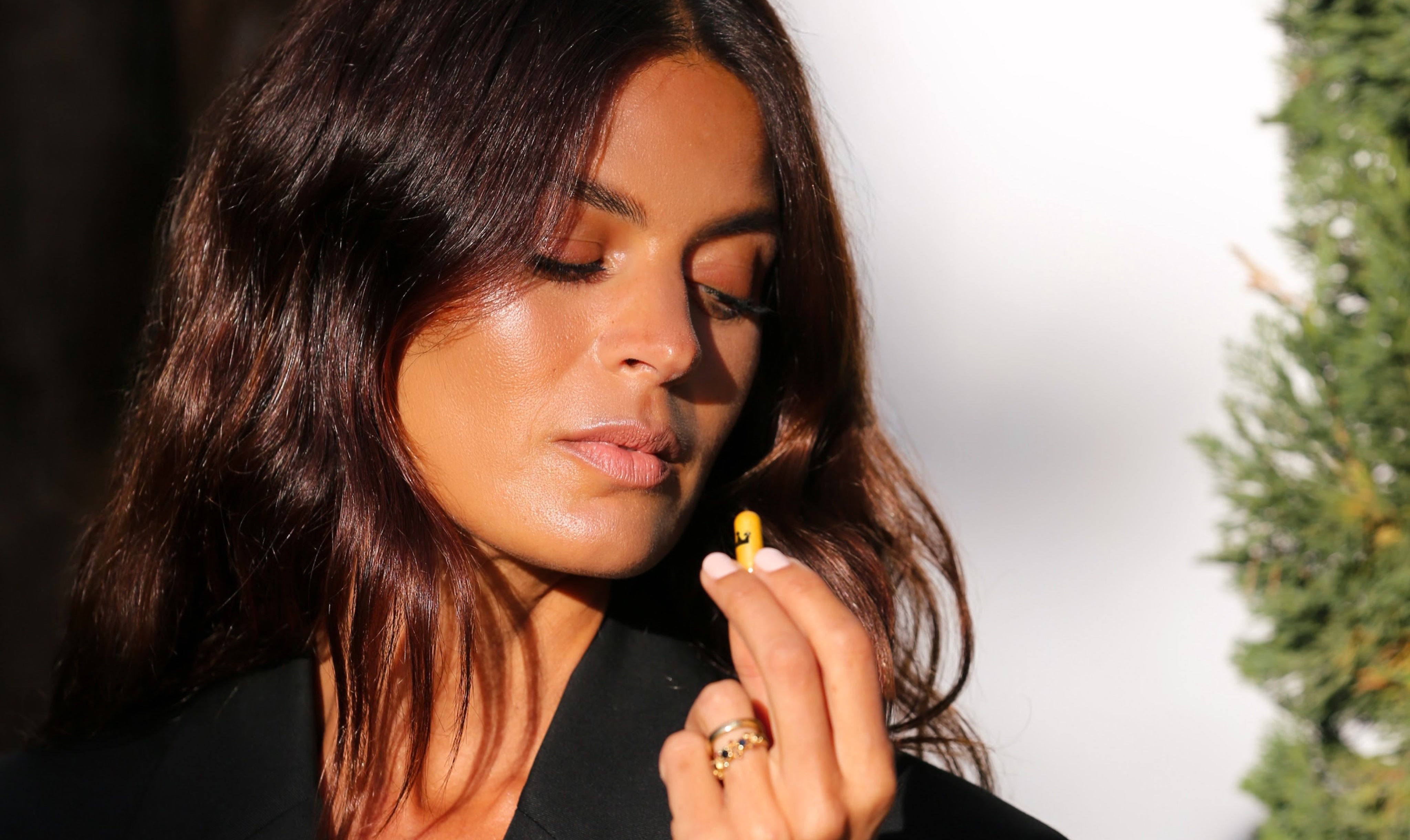
Three of the eleven patented ingredients in the LYMA Supplement have been studied specifically for sleep, separately from any alcohol-related research. In a randomised, placebo-controlled trial, an evening dose of affron®, a standardised saffron extract, was associated with improved sleep quality ratings and higher evening melatonin concentrations, measured directly in participants' saliva, compared with placebo. A separate randomised trial of 103 adults found that an evening dose of Levagen®+, a form of the fatty acid amide PEA, was associated with a shorter time to fall asleep and less grogginess on waking. Sensoril® Ashwagandha, studied separately for its role in the body's response to chronic stress, added a third angle - a meta-analysis pooling five trials in 400 adults found a small but significant effect on overall sleep quality. affron®, Levagen®+ and Sensoril® Ashwagandha are three of the eleven patented ingredients in the LYMA Supplement. Discover the LYMA Supplement.
The formula also contains Cognizin®, a patented form of citicoline studied specifically for attention and mental clarity - relevant on the kind of morning where focus is the first thing to go. A 2025 randomised, placebo-controlled trial found that daily Cognizin® supplementation improved attention-related performance in adults over 12 weeks. It isn't positioned as a hangover cure, and shouldn't be treated as one - but as a source of a well-studied nutrient for cognitive performance, it's a reasonable addition to a morning that could use it. LYMA ID²'s hydration-supporting mineral profile is worth knowing about for the same morning, too.
Why this matters beyond tomorrow's hangover
For more on better sleep, read 12 proven ways to sleep better, how much sleep you really need, and which natural supplements can help. Discover LYMA Supplement.
It's tempting to file all of this under "one rough night," but the pattern holds up over a much longer timeframe. A twin study following the same individuals across 36 years found that heavy and binge drinking were consistently associated with poor sleep quality at every single time point measured, regardless of the decade. Sleep problems and alcohol use appear to reinforce each other over time, not just overnight - which is a reason to treat the occasional bad night's sleep after drinking as useful information, rather than something to sleep off and forget.
Discover the patented, clinically dosed ingredients that work. See the verified science.
*This article is for general information and does not constitute medical advice. If you're concerned about your relationship with alcohol or ongoing sleep difficulties, please speak to your GP or a qualified specialist.
References
Alcohol, Wine, and Sleep in Adults: Insights from a Narrative Review. Nutrients, 2026. https://doi.org/10.3390/nu18040585
Kamaci, A. et al. Associations Between Self-Reported Daily Lifestyle Behaviors and Objective Sleep Parameters in a Large, Real-World Sample. Sleep, Vol. 49, Supplement-1, 2026, A571. https://doi.org/10.1093/sleep/zsag091.1277
The effect of alcohol on subsequent sleep in healthy adults: A systematic review and meta-analysis. Sleep Medicine Reviews, 2024. https://www.sciencedirect.com/science/article/pii/S1087079224001345
McGovney, K. et al. Sleeping It Off: Alcohol, Cannabis, and Alterations in Bedtime and Waketime in Women with Sleep and Pain Complaints. Sleep, Vol. 47, Supplement-1, 2024, A428. https://doi.org/10.1093/sleep/zsae067.0998
An investigation into an evening intake of a saffron extract (affron®) on sleep quality, cortisol, and melatonin concentrations in adults with poor sleep. Sleep Medicine, 2021. https://www.sciencedirect.com/science/article/abs/pii/S1389945721004330
Palmitoylethanolamide for sleep disturbance: a double-blind, randomised, placebo-controlled interventional study. Sleep Science and Practice, 2021. https://link.springer.com/article/10.1186/s41606-021-00065-3
Gopukumar, K. et al. Effects of Withania somnifera Extract in Chronically Stressed Adults: A Randomized Controlled Trial. Nutrients, MDPI, 2024. https://www.mdpi.com/2072-6643/16/9/1293
Cheah, K.L. et al. Effect of Ashwagandha (Withania somnifera) extract on sleep: A systematic review and meta-analysis. PLOS ONE, 2021. https://pubmed.ncbi.nlm.nih.gov/34559859/
Nakazaki, E. et al. Effect of citicoline supplementation on attention in healthy adults: A randomized, double-blind, placebo-controlled clinical trial. Presented at the 5th Symposium on Nutrition for the Ageing Brain, 2025.
Alcohol use and poor sleep quality: a longitudinal twin study across 36 years. Sleep Advances, 2022. https://academic.oup.com/sleepadvances/article/3/1/zpac023/6632721
Yu, F.C. et al. Effect of oral fructose on ethanol elimination from the bloodstream. Alcoholism: Clinical and Experimental Research. https://www.sciencedirect.com/science/article/pii/S1631069109000316


